Friday, February 18, 2011

Philatelic hanky-panky


The English expression  hanky-panky refers to activity that is devious or mischievous.  A common form of philatelic hanky-panky is the use of stamps prior to their official release date. 

Consider the Souvenir II cover below:

003

004

The Souvenir II surcharges were issued on May 27, 1923 -- the date shown on the stamps.  But the vertical strips of three on this 48-gram registered cover to Paris are postmarked at Wecker on May 23, 1923 -- four days earlier.  Even the poster stamp on the back is tied by a Wecker May 23rd cancel.  And there is also a Luxembourg-Ville transit dated May 23rd. 

That the return address on the envelope flap has been torn off also suggests hanky-panky.  Even today premature use of Luxembourg stamps is unusual, and certainly such use in the 1920s must have been a serious violation of government policy.  But knowledgeable collectors know that this cover was not the only hanky-panky that emanated from a certain entrepreneur in Wecker (and Berbourg)!  

The cover is overfranked.  At 48 grams, the postage would have been 70c plus a 50c registry fee, for a total of  1.20F.  The stamps affixed, however, total 1.50F. 

French customs was also curious.  The customs label indicates that the letter was to be held for customs inspection!

The handed-back cover below shows the stamps actually canceled on the first day of issue:

005

Saar Protectorate rates after World War I


Under the Treaty of Versailles, the Saar area was occupied jointly by the United Kingdom and France. In 1920, Britain and France established a nominally independent occupation government in an area separated from the previous Prussian Rhine province (main part) enlarged by two Bavarian districts (Homburg and St. Ingbert) ceded from the Palatinate.

This arrangement was sanctioned by a 15-year League of Nations mandate.   During the post-World War I mandate, mail from Luxembourg to the Saar Protectorate was charged the UPU rate.  Only after the Saar was returned to Germany did the German treaty rates again apply, beginning March 1, 1935.

Here's an example:

001

Vianden, transit Diekirch, to Dellingen, the Saar,
September 19, 1921

UPU 20g letter rate = 50c

UPU registry fee = 50c

The Souvenir I set (10c, 15c, & 25c) and the 50c Marie Adélaïde correctly pay the one-franc rate.  If the cover had been mailed to Germany, the treaty rate in September 1921 for 20g letters (30c) would have applied plus a 50c registry fee.

Check the covers in your collection posted between 1920 and 1935 to the Saar Protectorate.  Were they correctly rated?

002

In an earlier post, I showed covers paying the special post-World War II rates to the Saarland that were in effect from 1949 to 1958.  You can find the post here.

Wednesday, January 26, 2011

Modern Postal History Delights


Collecting modern postal history can offer you a lot of philatelic pleasure without emptying your bank account.  My "modern" Luxembourg collection begins with the issues of the late 1950s.  It has no arbitrary ending date. 

So-called "modern covers" are like young children.  They might not yet have found their place in the (postal history) world, but that will just take time.  Give them another fifty years to mature.  Collectors will look back over the immediate past 75 or 100 years, caterwauling about  the beauty of covers showing the rates, routes and markings of the latter half of the 21st century.  And some pundits will wonder why so many such covers were tossed in the bin by the 21st century postal historians.

Here are a few examples of delightful modern Caritas covers:


Domestic 1969 Registered Special Delivery Cover
with Mixed-Issue 1968-1969 Caritas Franking


005

Walferdange, transit Luxembourg-Ville [b/s], December 30, 1969, incoming to Strassen [b/s], December 31, 1969, for delivery in Bridel.

*  20-100g domestic letter =  6,00 F

*  Registry fee = 10,00 F

*  Special Delivery fee = 10,00 F

Correctly franked thus:

3F+50c 1968 Caritas (4) (valid only to the end of 1969),
2F+25c & 6F+1F (2) 1969 Caritas

Covers with mixed-issue Caritas frankings are scarce.  The Caritas issues prior to 1986 were only valid to the end of the year following their issuance.  Thus there typically were only a few days when both issues could be used.

For the cover shown above, the 1968 Caritas stamps were valid only to the end of 1969.  The 1969 Caritas stamps were issued on December 8, 1969.  Therefore 1968-1969 mixed-issue Caritas frankings were only possible for 24 days -- from December 8 to December 31, 1969.  You better check the bargain boxes at your favorite bourse to add a few to your collection!


The Elegance of Sole Frankings
on Correctly-rated Covers


001

 Weiswampach, May 5, 1959, to Mondorf-les-Bains [b/s], May 6th,
correctly rated 2.50F for a domestic letter up to 50 g, with sole franking of the 2.50F+50c 1958 Caritas Capellen coat-of-arms stamp.

Sole frankings exude the elegance of a beautiful flower in full bloom.  Searching for correctly rated, sole-franked covers for each value of a set is a worthy task, not easily accomplished! 


Postings to Exotic Destinations|
(such as Uganda)


002

Luxembourg-Ville, March 3, 1988, to Kampala, Uganda,
with three 1987 Caritas stamps paying 28F postage.


UPU 20g letter = 20F

Airmail supplement (3F/10g) = 6F (?)

(Overfranked 2F)


Highest Value of a Set Properly Used


003

004

Luxembourg-Gare, December 20, 1962, to Wandsbeker, Germany, franked with the 2.50F+50c and 8.50F+4.60F 1962 Caritas stamps.  The 8.50F is the highest value of the six-stamp 1962 Caritas set.

Assuming a 40-60g letter to Germany, the 11F postage pays:

1st 20g = 5F

Plus 3F for each add'l 20g = 6F


The auxiliary postal label applied at Lübeck indicates that the letter arrived damaged [Beschädigt] on December 21st.  It was repaired with eight official postal seals.

Sunday, January 09, 2011

300-day Journey to & from the Belgian Congo in 1902 -- a 'Philatelic Tragedy'

001
10c+10c Allegory Message-Reply Card (3rd series)
UPU-rate message-reply (double) cards can be the postal stationery collector's worst enemy or best friend -- your worst enemy if you lack incoming uses of the reply cards; your best friend if you have scarce incoming uses.
Well, while working on a one-frame exhibit of incoming uses of Luxembourg reply cards (and outgoing uses of other countries' reply cards posted from Luxembourg), I revisited this well traveled Allegory message-reply card with the unused reply card still attached.

boma

Here's this double card's apparent three-country, 300-day journey to the Belgian Congo and back:
July 29, 1901 to May 25, 1902
  • Alfred Beck, a student whose address is 5 Saarstrasse in Trier, Germany, writes to G. Kalber in Boma, the Belgian Congo, proposing an exchange of cards and stamps.  He dates the card 'Wasserbillig, le 28 juillet 1901,' and posts it on July 29, 1901 from Wasserbilling [large double circle cds].
  • The card arrives in Boma, Belgian Congo [blue-green cds] on August 27, 1901.  But where is Monsieur G. Kalber?
  • Auxiliary marks in French are applied:  'Retour a l'Expediteur' [at the bottom] and another at the upper left that I think indicates addressee unknown
  • Boma, April 29, 1902 [black cds struck twice], as the card is now being returned since G. Kalber hasn't called for it. The sender's name and address has been transcribed from the message side to the front in purple pencil for return to Trier.
  • Trier, Germany [bridge cancel], May 23, 1902.  Now the card is back to Trier, but the writer apparently isn't at 5 Saarstrasse anymore.
  • Auxiliary mark:  'REBUT' [dead letter] returned to Wasserbillig [May 25, 1902, large double-circle cds].
So, while interesting, this story is really a philatelic tragedy.  If G. Kalber had returned the reply card from Boma, we might now have an even more interesting story -- a reply card returned from Africa. 
By the way, double cards returned from Africa are quite a challenge.  I show an uprated G.D. Adolphe card returned from Tunisia here.

002
The writer's message

Sunday, January 02, 2011

Explaining two-country frankings on the Allegory postal cards


Explaining two-country frankings — occasionally found on the Allegory postal cards, especially during the 1890s —  challenges even the most erudite postal historians.  Here are four on which to test your knowledge.


1.  Bettingen to Stuttgart in 1894, redirected to
Munich, Germany


001a

Württemberg 5-pf definitive


001

10-centime Allegory postal card (3rd series)

Bettingen, 24 Feb 1894

* Stuttgart (faint incoming cds), 25 Feb 1894

* Stuttgart (outgoing), 26 Feb 1894

* Munchen [No. 1], 26 Feb 1894

While Württemberg and Bavaria were never separate UPU members, they participated in the UPU through the German Imperial Post Office.   Württemberg retained its postal autonomy until March 31, 1902; Bavaria until March 31, 1920.

From the inception of the Treaty of Berne on July 1, 1875, no additional postage was to be charged for the redirection of postal articles within the interior of the union.  So why was a 5-pf Württemburg stamp added when this card was forwarded to Munich?  The 10-centime Allegory stamp imprint paid the UPU postal card rate.  Perhaps because of the change in the addressee's name, five centimes were added to pay what I assume was the rate within Germany (from Württemberg  to Bavaria)?

004


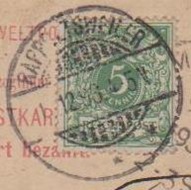
2.  Luxembourg-Gare to Rappoltsweiler in 1893, redirected to Hamburg-Hohenfelde, Germany
 

003a

5-pf German definitive


003

Message Card of a10c + 10c Allegory Message-Reply Card (3rd series)

* Luxembourg-Gare, 9 Dec 1893

* Rappoltsweiler, then German-Alsace, 10 Dec 1893

*Hamburg-Hohenfelde, 10 [or '11'] Dec 1893

As in the first example, a 5-pf stamp has been added to this card sent by the well-known Luxembourg rose growers, Gebrüder Ketten, when it was forwarded from Rappoltsweiler in the German Alsace to Hamburg, Germany.   (Rappoltsweiler, located in the Haut-Rhin department of today's French Alsace, is now known as  Ribeauvillé.)

  As the 10-centime Allegory imprint paid the UPU rate, was additional postage necessary to forward this card?


006


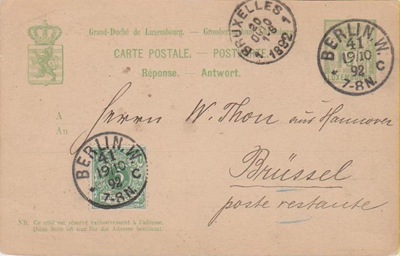
3.  Berlin, Germany to Poste-Restante, Brussels, Belgium
in 1892!


007a

5-pf German definitive


007

Reply Card of a 5c + 5c Allegory postal card (3rd series)

* Berlin, Germany, 19 Oct 1892

*Bruxelles, Belgium, 20 Oct 1892


Here the reply half of a 5c + 5c domestic message-reply card was posted from Berlin, uprated to the 10c UPU rate with a 5-pf German definitive, and directed to Brussels, Belgium!  Remarkably, no tax was charged.  Reply cards were supposed to be franked only with postage of the country of origin, which was only valid to return the reply card to the country of origin. 

Was this possibly a philatelic creation?

009


4.  Luxembourg-Ville to Cologne-Ehrenfeld, Germany
in 1892


008a

5-pf German definitive


008

5-centime Allegory domestic postal card (3rd series)

* Luxembourg-Ville, 21 Oct 1892

* Coln-Ehrenfeld, 22 Oct 1892


Here the uprating with a 5-pf German definitive to pay the UPU (and German treaty) rate is done in Luxembourg, but without the imposition of any tax, perhaps as a matter of convenience for the sender and acquiescence by the postal clerk.


010

Friday, December 31, 2010

A WWII Prisoner-of-war Camp in Moutfort?

image
Moutfort

Moutfort (Luxembourgish:  Mutfert; German: Mutfort) is a small village in the commune of Contern in southern Luxembourg.  Was a prisoner-of-war camp located there during World War II?  From the postcard shown below, apparently there was, but I can't find any documentation about the camp. 
 
003


004

This postcard is addressed to "Camp Mutfort (Luxembourg)," is dated February 10, 1946, and was postmarked the next day, February 11th, at Kirchworbis, a Thuringian town in the district of Eichsfeld in Germany.  It's nicely franked with a pair of the 8-pf definitive issued for the post-WWII occupation of Thuringia  (Scott No. 16N5) .

The card recently turned up in a collection of lagerpost letters sent to Luxembourg addresses.  I notice a couple vanity marks at the bottom right on the message side, so other collectors must have appreciated this card.

Does anyone know more about the detention of prisoners-of-war at Moutfort and the handling of their incoming and outgoing mail?

Sunday, December 26, 2010

Diagonal Paperfold on a 1947 1.50F+50c Caritas!

At Christmas, I enjoy revisiting my covers from the post-World War II era that are franked with the Caritas semi-postals, which appear in December each year.  These stamps were mostly used during the Christmas & New Year's season.  And until the 1986 issue, they were only valid for a short time, usually little longer than one year.  As a consequence, correctly franked commercial uses are well worth pursuing.
005a

005
The mixed franking seen on the cover shown above correctly pays the 3.50F 20g UPU letter rate from Luxembourg-Ville, January 9, 1948, to Zug, Switzerland.  But what's that white line across the 1.50F+50c Lentz 1947 Caritas stamp?  It's a paperfold, seldom encountered on any of the well executed Caritas sets of the late 1940s and early 1950s, and probably unique on cover.
So along with this engaging cover, I send Christmas greetings and New Year's wishes that you'll make many exciting philatelic discoveries in 2011!

Wednesday, December 08, 2010

April 10, 1931 -- Luxembourg's first airmail stamps used on a registered airmail letter to Liechtenstein on the first day of issue -- the beginning of two-country frankings?

 
1.  April 10, 1931 -- The beginning of two-country
airmail frankings?
On April 10, 1931, Luxembourg's attractive first airmail stamps appeared.  They were intended primarily for use on the country's airpost, which traveled by rail for dispatch from airports in neighboring Germany, France, and Belgium.  Direct airmail service from Luxembourg was not inaugurated until May 1, 1939.  During this eight-year-21-day period, Luxembourg airmail covers bear two-country franking -- the surface rate was paid with Luxembourg franking and the proper airmail supplement was paid with stamps of the country of dispatch.  But do not be confused -- these airmail stamps could be and often were also used for surface mail.
Basien and Hoffkamp, however, suggest  that airmail service using two-country frankings was possible as early as 1929, although I don't ever recall seeing a pre-April 10, 1931 Luxembourg airmail cover.  If such covers exist, they must be exceedingly rare.  Who has an example?
In their rate book, Basien and Hoffkamp quote Post-Instruktion 980/63, which in turn refers to Rundschreiben Nr. 80 dated May 7, 1929, thus:
Die luxemburgischen Postämter können einfache und eingeschriebene Sendungen der Briefpost annehmen, welche der Absender per Luftpost schickne möchte. Diese Sendungen unterliegen, außer den gewöhnlichen Gebührensätzen, einem speziellen Luftpostzuschlag, der unterschiedlich ist, je nach Fluglinie und Flugstrecke.
Provisorisch wendet die luxemburgische Post auf den Flugpostsendungen den Zuschlag an, der von dem Land festgesetzt ist, an das die Sendung vermittelt wird. Das Postamt Luxemburg-Stadt dient als Austauschbüro. Nur dort wird der Zuschlag in Briefmarken des betreffenen Landes aufgeklebt.
Für Luftpostsendungen, die in einem anderen Postamt aufgegeben werden, muss man sich an flogende Richtlinien halten:  Das Ausgangsbüro frankiert die Luftpostsendung gemäß dem normalen Tarif und schickt sie, zusammen mit einem formulaire de déboursé, enthaltend den Namen des Postamtes und der Aufschrift Avion an das Postamt Luxemburg-Stadt.  Dieses Amt klebt den Aufkleber Avion und die entsprechenden ausländischen Briefmarken als Zuschlag auf die Sendung, für den Leitweg, den der Absender angegeben hat.  Das Austauschbüro vermerkt den Zuschlagsbetrag in Luxemburger Franken auf dem formulaire de déboursé und schickt dieses dann zurück an das Ausgangspostamt.  Dieses Büro erhebt den entsprechenden Betrag beim Absender der Sendung, verrechnet die Summe in Portomarken auf dem formulaire de déboursé und sendet dieses zurück an die Postdirektion.  Folgende Angaben gelten als Richtinie für die Berechnung der Flugpostzuschläge:
Für die Lander Europas und Nordafrikas übersteigt der Zuschlag kaum 2.00 Fr.-Lux je 20 g.
Für die Flüge über Kairo nach Basra sind es etwa 3.00 Fr. je 20 g.
Für Nordamerika und Dakar etwa 4.50 Fr. je 20 g.
Für Südamerika (über Dakar) etwa 15.00 Fr. je 5 g.
Genauere Angaben können telephonisch beim Postamt Luxemburg-Stadt angefragt werden.

2.  An unusual first day of issue use of
the first airmail stamps

001
002 
Bernard Fetter sent the registered airmail cover shown above from Luxembourg-Ville on April 10, 1931, to Vaduz, Liechtenstein, franking the cover with a set of the four just-issued airmails.  The cover is endorsed "Einschreiben:  Mit Flugpost via Köln - Zürich - St. Gallen," and bears the following cancels:
  • Luxembourg-Ville, 2:00-3:00 p.m., 10 Apr 1931
  • Trier, Germany [b/s], 10:00-11:00 p.m., 10 Apr 1931
  • Köln, Germany Luftpostamt, 11 Apr 1931
  • Zürich, Switzerland Flugplatz Luftpost, 11 Apr 1931
  • Vaduz, Liechtenstein [b/s], 13 Apr 1931
A  German 20 pf. airmail adhesive pays the supplement for airmail service from Köln to Switzerland.
The cover is unusual for two reasons.  It does not bear the circular green cachet that was applied to the "official" first day covers for this issue.  All of these show the Luxembourg-Ville cds with the time indicated as 8:00-9:00 a.m.  This cover was posted later on the first day of issue.  The Luxembourg-Ville cds shows the time as 2:00-3:00 p.m.  The cover did not reach Trier, Germany until 10:00-11:00 p.m on April 10th.

3.  The typical first day cover with the special green cachet postmarked 8:00-9:00 a.m.

001a
001
A typical first day cover for the new airmail set is seen above.  It shows the special circular green cachet reading:
"Poste  Aerienne/ Luxembourg/10 Avril 1931"
Posted by Maury Swartz, the Luxembourg-Ville cds for April 10th shows the time as '8-9 M'.  The Brussels oval cds indicates that the cover was received in Brussels at 3:00-4:00 [a.m.?], April 11, 1931.  A Belgian 60c adhesive pays the airmail supplement for airmail service from Brussels to England.  The PAR AVION etiquette differs from that seen on the first day cover to Liechtenstein.

4.  Another 1931 two-country franking

 002
Luxembourg-Ville, August 3, 1931 (11:oo a.m.-12 noon) to Langenforth by Hannover, routed to Cologne for airmail service "Via Köln-Hannover," with the Köln cds of the same date, 9:00-10:00 p.m., canceling the German 10 pf. airmail adhesive that pays for the airmail service from Köln to Hannover.                             

Saturday, November 13, 2010

Sole use of the 87½-centime surcharge on the one-franc Marie Adélaïde definitive


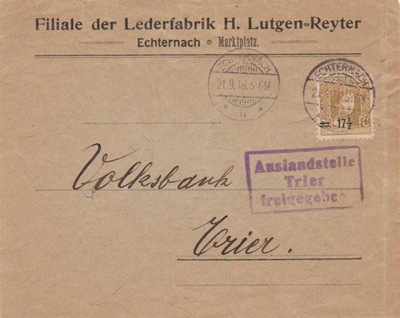
Why do we see so many covers—all philatelic creations—franked with the 30c Marie Adélaïde definitive surcharged to 17½c in combination with the one-franc surcharged to 87½c? There was no one-franc-five-centime rate, yet dealers often put optimistically high prices on these plentiful philatelic souvenirs.


The explanation is straight forward, and nicely explained in Hans von Rudolphi’s scholarly tome — Handbuch der Briefmarken-kunde: Lieferung 16/17 - Luxemburg, published in 1944. Here is a summary.


In July 1916, two new rates to Germany took effect: a 17½c letter rate and an 87½c rate for parcels weighing up to 5 kg. But to pay the latter rate, the 87½c William IV definitive (issued 6 Jun 1908) was no longer available. This stamp had been surcharged to 62½c on 29 Feb 1912. So to meet the immediate need for an 87½c stamp, Luxembourg on 14 Aug 1916 released the one-franc Marie Adélaïde definitive surcharged to 87½c (the 30c stamp was surcharged to 17½c to pay the new letter rate).

The 17½c and 87½c Marie Adélaïde definitives did not appear until 1 Mar 1917. Thus, the most interesting sole uses of the 17½c and 87½c surcharges are on letters and parcels sent to Germany between 14 Aug 1916 and 1 Mar 1917. And the most challenging use of the two by far is a proper sole use of the 87½c surcharge since very few parcel cards were saved.


The parcel card seen here is illustrative. It’s a proper sole use of the 87½c surcharge with the stamp paying the postage from Luxembourg-Limpertsberg, 2 Nov 1916, for a 950 gram parcel sent to Herne in Westfalia, Germany. The back shows the Luxembourg-Gare 3 Nov 1916 transit, the Trier, Germany, transit of the same date, and the Herne cds of 6 Nov 1916 documenting the arrival of the parcel.


Sole use of the 17½c/30c surcharge


Echternach II, 21 Sep 1916 to Trier, Germany

Typical Souvenir Cover Using the
17½c and 87½c Surcharges in Combination


Luxembourg-Ville IV to Berlin, 2 Oct 1916

An unreported 'Mondorf-les-bains' single line mark!

001b
Today I was studying a group of covers franked with the 1916-1924 surcharges.  And it's when you study material you've acquired, perhaps long ago, that you often make new discoveries.
001a
Here is a cover that initially interested me because the 17½c 20g letter rate and 25c registry fee to Germany were paid entirely with 1916-1924 surcharges.  But then I noticed something I hadn't seen before -- a curious single line strike reading 'Mondorf-les-bains' next to the registry mark.  There was also the Mondorf-les-Bains cds of  December 1, 1919 (and a Luxembourg-Ville transit backstamp of the same date).  So what purpose did the single line mark (with "Bains" strangely spelled with a lower-case "b") serve?
The strike remains a mystery for me.  Two numbers are written on the cover.  'No. 4' appears in black ink above the single line mark.  And above the registry mark in purple pencil '574' is written, which I assume  is the registration number.
Also, the cover is addressed to a philatelic organization (I think) in Ludwigslust (Mecklenburg), Germany.  Did the sender apply the single line mark before registering the cover?  And if so, why?
I occasionally see stamps canceled with a single-line device, presumably because the proper canceler was unavailable, but here the device was not used to cancel the stamps.
Got any clues?
001

Monday, October 25, 2010

The 1903 Diedenhofen-Mondorf railway revenue stamps

frachtbriefstempeldiedenhofenmondorf

The Alsace-Lorraine (in German: Elsaß-Lothringen) was a territory created by the German empire in 1871, after the annexation of most of the Alsace and the Moselle region of the Lorraine in the Franco-Prussian War as part of the Treaty of Frankfurt.  French troops entered the Alsace-Lorraine in November 1918 at the end of World War I, with the territory reverting back to France under the Treaty of Versailles in 1919.
In 1870, at the beginning of the German annexation, a set of postage stamps was issued for the Alsace-Lorraine.  But on January 1, 1872, these stamps were replaced by stamps of the German empire.
However revenue stamps for the Alsace-Lorraine continued to be issued throughout the annexation, including those to tax railway carriage of goods contracts (in French:  Lettres de Voitures).  
Of particular interest for Luxembourgian philately are the four revenue stamps issued in 1903 for use in connection with goods transported on the branch railway line [or Nebenbahn] from Diedenhofen (today: Thionville) in the Alsace to Mondorf-les-Bains in Luxembourg.  They are shown below:
Mondorf
The design is the same as that used for the main German railway in the territory -- the Reichs-Eisenbahnen in Elsass-Lothringen.  The text reads: 
"Nebenb.  Dieden-/hofen-Mondorf."   
The stamps are typically found perforated on some sides and rouletted on others.  The Yvert & Tellier Catalogue des Timbres Fiscaux et Socio-Postaux de France says the stamps rouletted on all four sides are scarce.
Similar revenue stamps were issued in 1905 for the  branch line connecting the Alsatian towns of Rosheim and St. Nabor.
Who has seen examples on documents?  Canceled examples of the 30 Pf. and 40 Pf. and a 1915 Frachtbrief from the line can be seen on this wonderful website:  http://www.rail.lu/lignesfr/lignethionvillemondorf.html
Your Luxembourg railway cancel collection won't be complete without the Diedenhofen-Mondorf railway cancel on a loose stamp or document!

Sunday, October 24, 2010

Mail to Louis Aston Knight's widow in 1949

Louisastonknight

Louis Aston Knight (1873–1948) was a French-born American artist noted for his landscape paintings. One of his paintings, The Afterglow, was purchased by U.S. President Warren G. Harding in 1922 to hang in the White House.
 
In early 1907, Knight met Caroline Ridgeway Brewster (1882-1959), a distant cousin from Rochester, New York, while she was traveling through Europe with her mother. Knight returned to America with Caroline in October; they married in Raritan, New Jersey. The couple settled in Paris, but lived in New York during WWI, moving back again to the United States in 1940 after the occupation of France, where they remained until their deaths. 

This letter from the United States Foreign Service in Luxembourg-Ville postmarked November 30, 1949, was sent to Louis Aston Knight's widow in New York City the year after his death.  The address--114 East 84th Street--is an eight-floor apartment building built in 1915.

84thstreet

The 4F, 20-gram  letter rate and 3F airmail supplement are nicely paid by the 7F 1948 Tourist View sole franking.

A thousand years from now, covers like this will be remembered as relics of the pre-electronic mail era.  So you'd better save 'em now!


Tuesday, October 05, 2010

If only it were still on cover ...

WmIV_Colmar_Berg
2½-fr William IV
Official
9 May 1912Colmar-Berg
Bridge & Bar cds

colmar_berg
Grand Ducal Chateau at Colmar-Berg

Fine used stamps evoke fantasies of the covers from which they were removed.  That's especially true when the cancel is that of Colmar-Berg, where much mail from the royals originated! 
The high denomination official stamp shown above might have franked a money letter sent back to Hohenberg in Bavaria, seat of the Nassau-Weilberg dynasty (such as the one shown below).  Of course, we'll never know for sure.

004
8175-Fr Money Letter
10c, 12½c, 62½c & 2½ Fr
Marie-Adélaïde Officials
Colmar-Berg, 6 Jan 1917, to Wiesbaden, 8 Jan 1917
Censored in Trier
From the Secretariat of
Grand Duchess Marie-Adélaïde
006
003
Correctly rated, thus:
Postage (20 g-250 g letter to Germany) = 30c
Registry fee = 25c
Money Letter fee (10c/300-fr) = 2.80 Fr
Total: 3.35 Fr