Thursday, October 22, 2015

Scarce postal stationery–the 1926 25c/20c surcharged Coat of Arms card (large format - 148x105 mm)


001a


Wiltz
24 Dec 1926
to
Dommeldange
25 Dec 1926

Earliest Reported Use


002


In response to the increase from 20c to 25c in the domestic postal card rate and the special rate to Belgium on August 1, 1926, an unknown quantity of the  20-centime large format (148x105 mm) Coat of Arms postal card was surcharged to 25 centimes.  Neither the quantity surcharged nor the date of issue is known.  The Luxembourg Handbook (2009) simply lists 1927 as the frühdatum, but the card shown here moves that date back at least to December 1926. 

Over many years, this is the only sole use I’ve found of this card; moreover, I’ve never acquired an unused example.  This card’s scarcity is surprising since the 25c domestic rate was in effect from 1 August 1926 to 1 April 1927 (243 days), and the 25c rate to Belgium from 1 August 1926 until 1 November 1926 (92 days ).  The obvious inference is that a very small number of 20c cards likely were surcharged.

Here’s an uprated use in January 1927 showing the 40c rate to France and Germany:


001


Mondorf-les-Bains
12 Jan 1927
to
Bonn, Germany

Oval Cachet:

Pharmacie des Bains
J. B. Harsch
Pharmacien
Mondorf-les-Bain


002a

Monday, October 19, 2015

Airmail Registered Échantillon sans valeur from Wiltz to New Zealand in 1952


IDEAL-Wiltz-1951-Nic.-Witry-Leder-Schuh-und-Fuss-(1)

Idéal Tannerie de Wiltz
Advertisement in 1951


004

Wiltz
9 May 1952
to
Wellington, New Zealand

Samples Bag – Leather Cuttings

50g-100g samples rate = 1.60 Fr
Registry fee = 4.00 Fr
Airmail supplement (10Fr/10g) = 60.00 Fr*

*Customs label indicates a weight of 60 grams

tannerie_ideal_wiltz

Ideal Tannery in the 1930s – It was liquidated in 1962

005

Registered Échantillon sans valeur from J. Moitzheim in 1928

Moitzheim

Since 1892


003


Registered Domestic
Samples Without Value
(“Ech. Recommandé”)

 
Wrapper Cutting

10c per 50g – minimum 35c
(1 May 1927 – 1 Jul 1930)

1 Fr registry fee
(1 Jan 1927—1 Jan 1930)

Luxembourg-Ville,
19 Nov 1928
to
Mersch

35c/40c Charlotte
(1st ser.)
with
1 Fr blue
Vianden Castle


J Moitzheim

Joseph Moitzheim


The Optique Moitzheim  continues in business today at 8 rue
Philippe II in Luxembourg-Ville and at four other locations in the country.

Échantillon sans valeur from Jean Peckels’ Tannerie de Vianden in 1928

vianden-gerberei1924


Peckels’ tannery in Vianden about 1924


002


Domestic Samples Without Value
Wrapper Cutting

10c per 50g – minimum 35c
(1 May 1927 – 1 July 1930)

Vianden,
7 July 1928
to
Luxembourg-Ville

35c/40c Charlotte
(1st ser.)

Peckels Vianden


On 6 Sep 1934, an announcement that the Tannerie de Vianden was not part of the Tannerie Ardennaise, which had gone into liquidation!

Friday, October 16, 2015

A Hand-Illustrated Postal Card – Japan to Luxembourg in 1900


Hand-illustrated postal cards will add a new dimension to your collection.  They are special because someone has taken the time to complement their message with a personal artistic expression. 

The gem below is one of my favorites.


002


001


Drawn at Kobe, Japan, 14 Jan 1900, by a passenger on the

S.S. Queen Eleanor, a steamship built in 1894.

Kobe, Japan, 15 Jan 1900

Transit Yokohama, Japan

Carlsbourg (Luxembourg), Belgium, 26 Feb 1900

Forwarded

Transit Luxembourg-Gare, 27 Feb 1900 [5:00-6:00 a.m.]

To Esch-sur-Alzette, 27 Feb 1900 [7:00-8:00 a.m.]

1 1/2 sen postal card uprated to 8 1/2 sen

Higgins & Gage # 31

Monday, October 05, 2015

A scarce 92-day 25-centime postal card rate to Belgium


001


25c on 15c Écusson Postal Card

Luxembourg-Ville, 29 Sep 1926,
to Ixelles-Brussels, Belgium

Type 1 Surcharge (sans serif ‘i’)

25c Postal Card Rate

To Belgium:  1 Aug 1926—1 Nov 1926
(only 92 days)


Sole uses (uses without adhesive stamps added) of the surcharged Écusson postal stationery issued in the late 1920s and early 1930s are surprisingly difficult to find.  One of the most difficult is use to Belgium of the 25c on 15c surcharged card during the 92-day period that the 25c rate to Belgium was in effect.  That rate took effect on 1 August 1926 and was effective for domestic postal cards and postal cards to Belgium.  But the 25c postal card rate to Belgium was increased to 30c just 92 days later on 1 November 1926, whereas the 25c domestic rate did not increase until 1 April 1927.

We do not know the quantity of 15c cards surcharged to 25c nor the date that they were issued. The Luxembourg Handbook (2009) reports the earliest known use date to be 11 September 1926.

Look for sole uses to Belgium during the 92-day 25-centime rate period.  They are scarce and will add value to your postal stationery collection.

Friday, October 02, 2015

35c Tandem Surcharges


Tandem


Sometimes you find philatelic beauty where you would least expect it.  Here the 35c surcharge on the double-surcharged 30c Écusson postal card appears in tandem with the 35c surcharge on the 40c Charlotte (1st series) definitive—certainly an unusual, if not unique, pairing!  The postal card is further enhanced by another pair—two 10c+5c Princess Elisabeth 1927 Caritas semi-postals.


001


Luxembourg-Ville
1 April 1928
to
Brugg, Switzerland

90c UPU Postal Card Rate


002


Incidentally, have you noticed that the single-bar 35c/40c/30c postal card was used mostly in 1928, but the double-bar version seems not to have appeared until 1929.  I’ve never seen a use in 1928.  The Luxembourg Handbook gives the single-bar and double-bar surcharged cards only one number (89); Prifix is more savvy, assigning numbers 83 and 83a to the single-bar and double-bar surcharges, respectively.  And I agree with Prifix that the double-bar surcharge is the scarcest.  Unfortunately, recent editions of Prifix no longer list postal stationery.  What a shame!

Thursday, September 24, 2015

Arsdorf–J. P. Kalbfleisch’s Private Cachet


Private cachets (or “chops”) are enjoyable, collectible, and fit nicely into my beyond-the-back-of-the-book albums. Think of the pleasure you’ll have finding chops while others pay inflated auction-house prices for often not-so-rare material.  You could specialize in one or a few professions or industries.  Take a look at this list for ideas:  http://www.industrie.lu/

Here’s a new addition from Arsdorf, the village of my maternal ancestors:


001a


J. P. Kalbfleisch
Tanneur
Arsdorf  Luxembour
g


002

Redange to Mertzig [post: Ettelbrück]
19 Sep 1884
5c Allegory (1st ser.) Postal Card

001

Thursday, September 10, 2015

Ephemera from Gemen & Bourg, Luxembourg’s magnificent rose grower


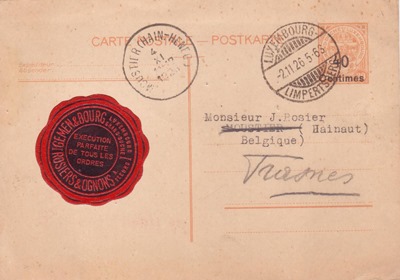
Collectors of Luxembourg postal history encounter a wide range of commercial correspondence from and to the Grand Duchy’s famous rose growers—in particular, Gemen & Bourg, Soupert & Notting, and Ketten Frères. Beginning in the mid-1800s, these firms produced a fine range of promotional postcards, advertising envelopes and other ephemera.

I especially like the example below, seen on a 1926 postal card—a red rose-shaped seal reading Gemen & Bourg, Rosiers & Ognons a. Fleurs – Execution Parfaite de Tous Les Ordres – Luxembourg Grand-Duche.  You’ll find many more.


002a

002

40c/30c Écusson Postal Card
(10c overpaid)
Luxembourg-Limpertsberg, 2 Nov 1926,
to Moustier, Belgium, 4 Nov 1926,
Forwarded
to Frasnes, Belgium

001

Used 349 days earlier than the 17 Oct 1927 frühdatum
in the Luxembourg Handbook.

Alex Sutton, in a Wikipedia article entitled Gemen & Bourg: Luxembourg Rosiéristes (http://www.helpmefind.com/gardening/), provides a delightful brief history of the firm, which I’ve reproduced below.

According to tradition, it was in 1888 that Charles Gemen and his brother-in-law, Melchior Bourg, established Gemen & Bourg in Luxembourg-Limpertsberg. In his research, Raymond Weiller uncovered catalogs dating from at least one year before this that would indicate that Charles Gemen had been in the nursery business before 1888. Melchior was married to Charles' sister, Marie Françoise. He retired in 1896, but the firm continued to be known as Gemen & Bourg.

The nursery comprised about 35 hectares (approximately 76 acres) which made Gemen & Bourg the largest firm of its kind in Luxembourg and one of the most important in Europe. It became known as the largest exporter of roses in the world. Annually, from 1900 to 1914, Gemen & Bourg produced and sold from 2 to 3 million roses. In reality, the number of roses they exported exceeded that number because the firm purchased additional plants from smaller firms.

Unlike Soupert & Notting, Gemen & Bourg were primarily rose-growers and introduced only five of their own hybridized varieties. Among these was a light orange climber called 'Manette Gemen'.

In the Autumn 1887/Spring 1888 catalogue, Charles Gemen presented himself as a horticulturalist-nurseryman. His catalogue listed over 500 roses, 58 fruit trees, other trees of various types and strawberries. The price of the roses varied from 55 centimes (half a franc) to 1,25 francs with the majority of plants being sold for for 60 to 65 centimes. New varieties from 1884 to 1886 were offered at even higher prices which could reach 1.75 francs. There was one exception to this and that was the rose, 'Souvenir de Victor Hugo', a large-flowered Tea rose with blossoms that are a dazzling China pink with yellow centers. This was the most expensive rose in the catalogue at 2 francs! Writer Victor Hugo had passed away in the year before this rose was introduced.

Charles Gemen finally referred to himself as a rosériste for the first time in the 1890-1891 catalogue. By this time, the firm offered 534 varieties of roses. Two years later, this number had more than doubled to over 1,146. Almost thirty years later, and in addition to 2,490 varieties of roses and a considerable number of other flowers, the catalogue from 1926 offered selected seeds of choice and diverse exclusive specialties: seeds for the vegetable garden, seeds of medicinal plants, flower seeds, etc.

Unfortunately, as it happened with Soupert & Notting and other firms, World War II saw the end of Gemen & Bourg.

Tuesday, September 08, 2015

World War 1 Aftermath—Free Frank of the Luxembourg Delegation to the CICFC in 1919


001


The 1918 Armistice led to the creation of new logistics agencies.  Among these were the Commission Interalliée des Chemins de Fer de Campagne des pays rhénans (the CICFC) and the Commission des Chemins de Fer de Campagne d’Alsace-Lorraine.

Lars Böttger, in his recent tome on Luxembourgian WW1 postal history, notes that “[i]n Luxemburg sind mehrere Stempel im Einsatz, die von alliierten Kommissionen stammen. Die Stempel sind alle selten und konnten bisher nur ein bis zwei Mal registriert werden.” (Handbuch zur Besetzung von Luxemburg im 1. Weltkrieg 1914-1918 und der alliierten Besetzung at § II.A.4.5 Alliiete Nebenstempel, p. 100. See also p. 40.)


001


002


The CICFC free frank shown here is on a picture postcard of the Kunst Museum at Trier. The card is dated “Luxembourg le 18 Aout 1919” and addressed to Salettes par Monastier in the Loire. The purple double-ring free frank reads:

C.I.C.F.C. DES PAYS RHÉNANS

Délégation

de Luxembourg

Commandant

H. Poupart

It’s a WW1 postal history treasure!

* * *

A similar free frank (shown below) was used by the Cologne commission:


Campagne


Campagne

Thursday, September 03, 2015

Marie-Adélaïde Perforation Varieties


002a

Beware!  What may be offered as imperforate at the bottom may just be a misperforation, as shown above.  Better to acquire a full margin copy.


002b

Here is the result of misperforating the top row—the stamps are truncated at the top.


002c

Two perforation rows on the left side.

Marie-Adélaïde Paperfolds


001a


Double Paperfold

Esch-sur-Alzette
Usines Gelsenkirchen
cds


001b


Paperfold

Rambrouch cds – 1919

Searching kiloware for cancels can yield unexpected results, as seen here!

Tuesday, August 25, 2015

5 pf. German Reply Card Returned from Luxembourg-Gare to Metz in 1907—Why was it Taxed?


001


Luxembourg-Gare B
17 Sep 1907
[8:00-9:00 a.m.]

Metz
17 Sep 1907
[1:00-2:00 p.m.]


002


Why was the card, which was sent on 17 September 1907, taxed [hs ‘T’ and ms 10 in blue crayon]?  I’m not sure.

Luxembourg’s postal card rate to Germany was not increased to 10 centimes until 1 October 1907.  However, the German rate for foreign postal cards had already increased to 10 pf. on 1 July 1906, but I believe the 5pf rate to Luxembourg remained in effect for several years thereafter.  So, perhaps the Luxembourg postal clerk , not realizing that the card was the reply-part [Antwort) of a 5pf+5pf German message-reply card, mistakenly treated it as an ordinary German postal card improperly posted from Luxembourg.

The card is Michel P71Y; it’s quite scarce used, particularly used internationally.

Monday, August 10, 2015

Sunday, June 14, 2015

Was Use of Postal Stationery Cutouts Ever Permissible in Luxembourg?

We occasionally see cutouts from postal stationery used as postage.  I’ve always been uncertain whether this practice was permitted within Luxembourg (and within the UPU mails generally).  In Great Britain, for example, the postal use of cut-outs was banned under the Post Office Act of 1870 when wrappers and postal cards were introduced. This prohibition remained in force until 31 December 1904.  And the current United States Postal Service Domestic Mail Manual at 604 Paragraph 1.3(d) provides, in part, that stamp imprints cut from stamped envelopes, aerogrammes, or stamped cards are invalid to pay postage for U.S. domestic or U.S.-originated international mail.

But what about Luxembourg?

Here are three examples—one from 1892, another from 1915, and a third from 1935.  Only one was taxed:

5-centime Green Allegory Postal Card Cutouts 
pay postage on a UPU letter
to Switzerland
in 1892

 001a
001
 

25-centime UPU Letter
Luxembourg-Ville, 21 Aug 1892,
to Bern, Switzerland

 
002


5-Centime Arms Postal Card Cutout
pays postage on a Letter to France in 1915
from Carmelite Nuns in Luxembourg
with the Cutout use taxed

 
003a
003
 

Luxembourg-Ville, 5 Feb 1915?, on a 10c/20g letter to Paris, France,
with reverse cachet of the Carmelites Tertiaires, Luxembourg

 
004

004x


40c Charlotte Postal Viewcard Cutout
Pays Postage on a Domestic Advertising Cover
in 1935


Luxembourg-Ville, 17 Oct 1935, to Limpertsberg
at the 75c Domestic Letter Rate