Wednesday, July 04, 2012

Incoming mail to Arsdorf in 1891 & 1893


From Germany in 1891 


001

Leipzig, Germany, 12 Jun 1891

Luxembourg-Gare B, 13 Jun 1891

Rambrouch, 13 Jun 1891

Common postal cards, such as this Michel P21, sometimes contain hidden treasures for the postal historian!  Here we see a message to Arsdorf from a bookstore in Leipzig long before the days of instantaneous electronic communication.  The lovely printed back is a bonus.

002

F. A. Brockhaus, Leipzig

Buchhandlung für deutsche und ausländ

From Belgium in 1893

003


Estinnes, Belgium, 16 Aug 1893

Luxembourg-Gare B, 17 Aug 1893

004


Sunday, June 17, 2012

The Non-denominated Chancellerie Essay (or Proof) – Where is it now?


Chancellerie_proof

Serge Ungeheuer’s Banque du Timbre held its 141st auction on December 13, 1986.  Auction lot 839 was described as:

ESSAI de timbre fiscal sans denomination de valeur, en noir sur petit Feuillet, épreuve d’artiste et épreuve de luxe. PROBABLEMENT UNIQUE.  Photo [shown above].

Since 1986, various proofs of this beautiful Chancellerie issue have emerged, including those shown below from a Christie’s auction, but they are denominated proofs.  The non-denominated essay (or proof) has never been seen again to my knowledge!

Chancellerie Color Proofs

001a

001b

001c


Used on a Passport

002

Thursday, May 17, 2012

Collecting Incoming Postal Stationery

If you enjoy postal stationery (as I certainly do), you might consider collecting postal stationery to Luxembourg as part of your stationery collection.  Soon you’ll have a worldwide collection of postal stationery with an obvious connection to Luxembourg!  And with major auction catalogs searchable by key word, you’ll readily find some unusual items!

Here are a couple recent examples:

Germany’s First Postal Card
used to Diekirch in 1874

003

004

Saarlouis, 8 Aug 1874, transit Luxemburg-BHF [b/s],
8 Aug 1874, Diekirch [b/s], 9 Aug 1874


Incoming Postal Stationery from 
the Gold Coast in 1905


001


002


Gold Coast 2p registry stationery uprated 2½p

Accra, Gold Coast Colony, 9 Jan 1905, Plymouth, England transit, 26 Jan 1905, London registry [red b/s], 27 Jan 1905, Luxembourg-Gare transit, 28 Jan 1905, received Esch-sur-Alzette, 28 Jan 1905.


German Control-Dated Postal Stationery


003a

Or, if you are budget-minded, consider collecting German control-dated postal cards used to Luxembourg.  These can often be found for a few Euros on websites such as Delcampe or at bourses. 

Michel’s Ganzsachen-Katalog Deutschland lists hundreds of these, ranging from Michel P 12a (1882) through P 48b (1900).  A collection of 50 would make a delightful showing.  Somebody should publish a checklist (maybe the German collectors have). 

A multi-frame exhibit of incoming control-dateds might not appeal to stamp show judges whose prejudice for rarity over challenge often is all too evident, but unlike JPMorgan, you won’t suffer a two billion dollar trading loss collecting the control-dateds!

Here’s an example (the control is at the lower right):

003

Holsthum, Germany, 20 Mar 1892, to Grevenmacher, 21 Mar 1892,
Michel P25a (10 pf. Eagle-in-Circle) with
Control 191 g [for January 1891].

Sunday, May 13, 2012

Nachgebühr


If you collect Luxembourg’s World War II German occupation stamps and covers, you’ve probably encountered examples with a narrow rectangular cancel reading Nachgebühr in German [English: postage due].  Here is an attractive example that I recently acquired:


001 

Domestic registered letter from Ettelbrück to Bourschied sent unfranked in late 1940 or early 1941 (based on the franking) by the Ettelbrück Nutrition Office with postage due of 46 Rpf. (12 Rpf. 20g letter + 30 Rpf. registry fee)

Germany has never used postage due stamps, so it is unsurprising that they did not issue such stamps for use in Luxembourg during the WWII occupation.  Instead, after Luxembourg’s pre-occupation stamps were demonitized on October 1, 1940, postage due payments during the WWII occupation were documented by affixing and cancelling then-valid stamps with an undated Nachgebühr cancel, as seen above..

The Prifix catalog illustrates four varieties of the 35 x 10 mm. Nachgebühr cancel – two in Gothic letters and two in Latin letters.

001

Who has all four varieties in their collection?

Covers showing use of this cancel are fairly difficult to find.  Initially, the stamps documenting the postage due payment were affixed to the front of the cover and cancelled Nachgebühr in black; later, the stamps usually were affixed to the back of the cover and cancelled Nachgebühr in red or violet, with the amount due often shown on the front in blue crayon.

002a


003a

Local letter from the Luxembourg-Ville Wirtschaftsamt [Management] Office to the suburb of Limpertsberg, May 15, 1941, charged postage due of 8 Rpf. (the local letter rate), endorsed at the top Portopflichtige Dienstsache [recipient pays the postage as postage due].

002b


003b

Special delivery money letter, insured for 150 RM, posted stampless within Wasserbillig, July 19, 1941.  Charged 1.70 RM postage due (insurance fee = 1.00 RM + 30 Rpf. registry fee + 40 Rpf. special delivery fee).

Saturday, May 12, 2012

Luxembourg-Journaux: An Uncommon Bridge-and-Bar Cancel


004a


004

Here is the elusive bridge-and-bar cancel on a 21g registered stampless cover, postmarked Luxembourg-Journaux,
6 Oct 1916, endorsed Postamtszeitungsstelle/Luxemburg-Stadt [Post Office Newspaper Office] at the lower left, censored at Trier, Germany, and posted to and backstamped at Berlin, 8 October 1916. 

The official envelope is coded ‘No. 125. – 1916.’

The FSPL cancel catalog erroneously lists the initial date of use of this cancel as 12 July 1940. 

Curiously, the only example I’ve found on a loose stamp is on the 1920 30c/25c surcharged postage due stamp (Prifix 9).

Saturday, March 31, 2012

Does anyone still collect blocks?


007


In the post-World War II era, mint blocks of three-cent commemoratives were widely collected in the United States. And even kids in my Minnesota village could afford to buy blocks of all the new issues given the government’s restrained issuance policy. In my birth year, for example, the United States issued only seven commemoratives--all in three-cent denominations. At the post office window, the total cost for the seven blocks was only 84 cents ($8.11 in today’s money, after you adjust for inflation).

Back then, we were impressed by a local banker who could afford to collect full sheets of these commemoratives. His investment was considerably greater than ours ($10.50, or $101.37 in today’s money).  But with the glut of new issues that the USPS churns out these days, that banker today would be collecting singles!

As an investment, these blocks of commemoratives paid no dividends, but at the end of the year I had a nice showing to display of what the government had released over the past 12 months.  Admittedly, I used them long ago for postage. But remembering the pleasure of collecting blocks back in the 1950s, I’ve started a collection of Luxembourg covers franked with blocks.

Here are a few recent and not so recent additions:

75c (+20c) 1927 Caritas
Princess Elisabeth

001

Junglinster, 20 Feb 1928, transit Luxembourg-Ville [b/s],
to Zürich, Switzerland [b/s], 21 Feb 1928

UPU 20g letter rate = 1.50 F
UPU registry fee = 1.50 F

002


60c (+10c)  1929 Caritas
Princess Marie-Adélaïde


005

Luxembourg-Ville, 9 Jan 1929, Brussels, Belgium, 9 Jan 1929,
London registry [b/s] & London Dulwich [b/s], 11 Jan 1929

UPU 20g letter rate = 1.50 F
UPU registry fee = 1.50 F
Belgian airmail charge = 75c

006

10c + (5c) 1930 Caritas
Prince Charles

005

Remich, 9 Jan 1931, to Breedene s/Mer, Belgium,
75c 20g concession letter rate to Belgium

10c (+ 5c) 1932 Caritas
Countess Ermesinde

006

Luxembourg-Ville, 2 Jan 1933, to Versailles, France,

1.25F 20g concession letter rate

10c (+ 5c) & 35c (+ 10c) 1934 Caritas
John the Blind


007a

007b

Registered 20g UPU letter to Austria posted 19 Dec 1934
from Luxembourg-Ville (overfranked 5c)


12½c G.D. Adolphe
definitive


003

23g letter, Luxembourg-Ville, 2 Feb 1904, to Trier, Germany [b/s]

20g-250g letter rate = 25c

Registry fee to Germany = 25c

004


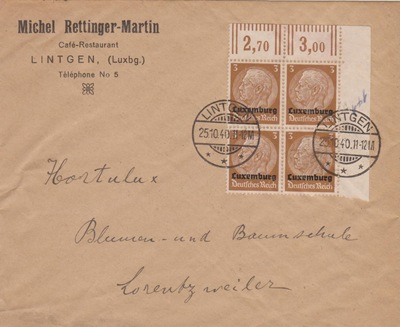
3 Rpf. Hindenberg
(WWII Occupation)
 

004

Lintgen, 25 Oct 1940, to Lorentzweiler, 12 Rpf. letter rate

Tuesday, March 13, 2012

Dachau to Pétange in June of 1944 – mail from Prisoner No. 64388 – Johann Scholtes


004a


004

WWII concentration camp mail -- Dachau, 7 June 1944, to Pétange

When I find a prisoner-of-war or concentration camp cover, I often wonder who the writer was and what happened to them.   One such cover is shown above.  It was sent from Dachau in June 1944 by Luxembourger Johann Scholtes of Pétange, who was born in Roeser on 20 November 1892. 

The Dachau records indicate that Scholtes was transferred to Dachau on 26 February 1944 from the Hinzert concentration camp, where many members of the Luxembourg resistance were confined.  He was assigned No. 64388 and imprisoned in Block 2/2 3K.

The United States Army liberated the Dachau concentration camp on 29 April 1945.  Some 428 days after he had arrived, Johann Scholtes was one of the prisoners liberated on that day.  Presumably he was repatriated to Luxembourg, although I don’t know the rest of his story.

Here is his letter home, still contained in the cover, and bearing the Dachau camp postal censor’s cachet at the end:

005

007


006

Finding covers with unusual rates or to uncommon destinations is especially challenging for collectors of modern postal history


001a


Covers with exotic contemporary uses are more difficult to find than in the past. Even common uses franked with definitives or commemoratives can be elusive as the use of electronic mail and social media, such as Facebook and Twitter, supplant personal and business mailings.  And today many companies shred their incoming commercial covers to comply with privacy laws and frank their outgoing mail with meter imprints.

Fortunately there still is a small number of collectors of modern postal history who actively search for and save what little of this scarce material that remains to be found.  If postal history collecting survives into the 22nd century, these covers will be the gems of the future.

Here are a few examples from my collection of incoming airmail to Luxembourg from the United States:


30c per ½ oz. Airmail Rate to Europe

28 Apr 1939 to 1 Oct 1946

003b

Carey, Ohio, 25 Sep 1946, to Rodenbourg, Luxembourg, with
30c Theodore Roosevelt Presidential Issue sole franking.

30c per ½ oz. Airmail Rate to Europe

28 Apr 1939 to 1 Oct 1946
+

20c Registry Fee

1 Feb 1945 to 1 Jan 1949

002

003

New York, NY, 26 Jul 1946, transit Luxembourg-Ville, 30 Jul 1946, received Mondorf-les-Bains [German cds with “Bad” excised]

15c per ½ oz. Airmail Rate to Europe

1 Oct 1946 to 7 Jan 1968

003a

Chicago, Illinois, 25 Apr 1964, to Rodenbourg, Luxembourg, with
15c Montgomery Blair commemorative airmail sole franking.

21c per ½ oz. Airmail Rate to Europe &
60c UPU Special Delivery Rate

21c Airmail:  1 Jul 1971 to 31 Dec 1975
60c Special delivery:  16 May 1971 to 18 Apr 1976


001 

Kansas City, Missouri, 26 May 1973, to Neiderwiltz, Luxembourg, with backstamps of Luxembourg-Ville and Wiltz on 30 May 1973.

The 21c airmail nicely pays the airmail postage, while the 60c special delivery stamp pays the special delivery fee.  Posted by Robert F. Schaeffer, Luxembourg’s honorary consul in Kansas City at this time.

002

Sunday, March 11, 2012

Boulaide to Prinkipo, Iles des Princes, Turkey, in December 1921, showing registered sole use of the one-franc Marie-Adélaïde


Unusual origins coupled with exotic destinations—that’s what adds gusto to a cover collection.  Here’s an example.

001


002


Boulaide, 19 December 1921, to Prinkipo,
on Turkey’s Princes’ Islands

The one-franc Marie-Adélaïde definitive nicely pays the 50c UPU 20g letter rate and the 50c registry fee, both rates having taken effect on May 10, 1921.  The backstamps show transit through Galata in Istanbul on December 26th to Prinkipo, on the big island of Büyükada, the largest of the nine so-called Princes’ Islands in the Sea of Marmara, near Istanbul.

One can only wonder what the writer from Wiltz, who posted this letter from Boulaide during the winter of 1921-22, was telling his correspondent in Turkey, who might have been sunbathing that winter’s day on the Prinkipo beach.

image

Here’s an old postcard showing the beach near Prinkipo:

image


I seldom find a Marie-Adélaïde cover that I dislike (just ask the German dealers who visit Bangkok!), but this well-preserved gem is a very special addition to my collection of one-franc Marie-Adélaïde covers.  I’ll surely be thinking of it my next visit to the quaint villages around the Lake of the Upper Sûre.