Saturday, August 21, 2010

The sad plight of stamps in the postal history era


WmIV


Here are two lovely William IV stamps:  the 2½ F with the cds of Colmar-Berg, 6 May 1913, and the 5 F official, with the cds of Luxembourg-Gare.  Both carry hefty catalog values in Scott and Prifix:

  Scott 2009 Classic Prifix 1997
2½ F Wm IV $ 91.50 € 100
5 F Wm IV official $ 47.50 60


As a juvenile collector in the 1950s, I built a worldwide collection with penny approvals.  It was many years later before I could acquire gems like these.  And then, they were not acquired for pennies!

But today you can buy stamps like this for little more than I paid for  penny approvals in 1955.  These two stamps — offered as "Luxembourg Mi 82-3 used stamps CDS cat 165 euro" — sold for $20.50 (plus $1.28 shipping) after drawing two bids on eBay on August 1, 2010.  In 1955 dollars, that would have been $2.56 (plus 16c postage).  And whether in 1955 or 2010 dollars, that is little more than chump change for these two scarce stamps.

Granted, the 2½ F might not be as scarce as its catalog value suggests, but with the Colmar-Berg cancel it holds its own in my collection of bridge & bar cancels, some of which are shown below.  And my experience has been that the used 5 F official is considerably scarcer than the used 2½ F definitive, catalog values to the contrary notwithstanding.

Results such as this are commonplace on eBay.  So when reading catalog values for most 20th century Luxembourg stamps, just move the decimal point one place to the left.  The prices will then be a lot closer to actual market value, given the increasing amount of material entering the market and the paucity of collectors who still collect 20th century stamps. 


Colmar_Berg_bridge_WmIV

Colmar-Berg
Bridge-and-Bar cancels
FSPL Type 33


Sunday, August 15, 2010

'Via Marseille' & 'Via Troisvierges' to Diekirch


001

Incoming international mail to Luxembourg almost always transited Luxembourg-Gare or Luxembourg-Ville for delivery to outlying towns.  But here is an exception.

This well-preserved UPU postal card emanated from Weltevreden in the then-Netherlands East Indies, January 18, 1888, addressed to Diekirch.  The Dutch rectangular auxiliary marking reads 'NED: INDI/VIA MARSEILLE,' so we know that the European port of entry was Marseille.  But the incoming postmark on the morning [10:00 to 11:00 a.m.] of February 22, 1888, is that of Troisvierges!  The  postmark of Diekirch [7:00-8:00 p.m.] shows that the card arrived later the same day.

We will never know why this card managed to travel from the  south of France by rail through Luxembourg-Ville (and presumably past Diekirch) to Troisvierges in the far north, only to be routed back to Diekirch in central Luxembourg for delivery. 

Ah ... if postal cards could talk, what a delightful story many of them could tell!

002

Well, they can sort of "talk."  Take a look at the cross-writing on the back of this card.

See also:   Outbound mail to Sumatra (1901) & Java (1924)  (posted July 5, 2009).


Sunday, April 25, 2010

Luxembourg's use of official seals to repair damaged incoming and outgoing mail


To my knowledge, almost nothing has been written about the official seals used by the Luxembourg postal service to officially seal or reseal  damaged incoming or outgoing mail.  This is surprising as postal historians have recently shown a keen interest in this aspect of postal history. 

The fine website Officially Sealed Mails of the World at  www.poseal.com is devoted to documenting and displaying worldwide official postal seals.  According to the website author, Todd A. Hirn, "The earliest recorded on-cover use of an official seal was in Italy in 1864."  He says that official seals have been recorded from some 185 countries.  However, he notes that few countries continue to use post office seals today.  Most postal authorities now use special tape to repair damaged mail, or they enclose badly damaged items in plastic 'body' bags.

Surely the readers of this blog can help me document the official seals that the Luxembourg post has used.

Here are three examples of such mail.  These imperforate translucent glassine seals were used to repair damaged mail.  They are easily differentiated by their fancy corner ornaments, the text and text font. (I classify them separately from the attractive small embossed seals that the Luxembourg post and many other government agencies once used to "seal" their outgoing mail.)


1921 twice resealed registered letter
Brod, Yugoslavia to Berbourg, Luxembourg


003aa

002a

001aaa

Corner ornament

Registered letter from Brod, Yugoslavia [today:  Croatia] posted October 18, 1921, to Berbourg, Luxembourg [misspelled:  'Bernburg Luxenburg'], franked with six 25-para King Alexander definitives and a 1-dinar King Peter definitive (Scott No. 6 and 10, respectively).

The letter was initially routed to Dresden, Germany [cds 21 Oct 1921], where it was opened for inspection under the German currency control laws and officially resealed. 

Due to the misspelling of Berbourg, the letter was missent from Dresden to Bernburg, Germany [on the back:  Bernburg cds 14 Nov and 15 Nov 1921]. 

The letter was then redirected to Luxembourg-Ville [cds illegible].  As it was extensively damaged, it was officially resealed before being sent on to its destination in Berbourg [post:  Wecker cds, 17 Nov 1921].

The official seals read:

ADMINISTRATION /DES POSTES ET DES/TELEGRAPHES/LUXEMBOURG


1933 underpaid letter from
Lisbenge, Belgian Congo
to Luxembourg-Ville

002a

001aaa

004a

Corner ornament

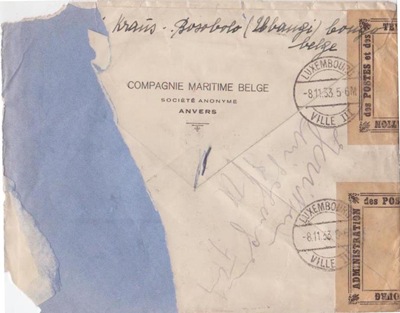
Letter from Libenge, Belgian Congo [today:  Democratic Republic of the Congo] posted 29 Sep 1933 to Luxembourg-Ville.  The 1.25 F Belgian Congo pictorial only paid the treaty rate to Luxembourg for a 20-gram surface letter.  An additional 75c postage was required for second-step (20-40 gram)  letters, as apparently was the case here.  The 75c deficiency was doubled upon receipt in Luxembourg-Ville, 8 Nov 1933.

Arriving badly damaged, the letter was resealed with two official postal seals.  They read:

ADMINISTRATION/ des POSTES et des/TELEGRAPHES/LUXEMBOURG


001aaaa002az 


1936 letter from
Luxembourg-Ville to Berlin, Germany
damaged by the machine canceller

Officail postal seal cover

Official postal seal cover bk 

Official postal seal coveraaa

Corner ornament

Meter mail machine cancelled at Luxembourg-Ville, 2 Apr 1936, posted to Berlin, Germany.  The postal clerk's pencil notation in French on the back reads "damaged by the machine canceller." 

The meter franking of 2.75 F pays the treaty rate to Germany for a third-step, 40-60 gram letter.  The thickness of this heavy letter probably was the cause of the damage from the machine canceller. 

The letter has been repaired with an official seal that reads:

POSTES,/ TELEGRAPHES/ et TELEPHONES/ LUXEMBOURG

Wednesday, April 14, 2010

Double Overprint on 2c Écusson Official (unlisted in Prifix)


001

Prifix 97
Double Overprint


Capture2010-4-15 12-16-14-6


Prifix lists only the 4c Écusson official with a double overprint (Prifix 98a).  But here also is the 2c Écusson official with a double overprint!

I was pleasantly surprised to find this double overprint in a box of Luxembourg stamps on old printed album pages.  I had cannibalized these album pages years ago, taking out the used stamps, especially those with interesting cancels, to be soaked and sorted.  Now, years later, I've finally gotten around to removing the mint stamps.  This unexpected discovery made my long delayed effort seem worthwhile!

Has anyone else found this stamp with a double overprint?

Thursday, April 08, 2010

Postcards that had to pay the foreign letter rate!


From 1902 to 1907, certain postcards had to be franked at the foreign letter rate.  The picture postcard shown above illustrates this fact.  I doubt that many postal historians could correctly explain the rationale for the regulation.

The postcard was sent on August 28,1905, from Luxembourg-Ville to Havelange, Belgium.  It was franked with a pair of the five-centime Adolphe definitive correctly paying the ten-centime UPU postcard rate.  But nonetheless it was taxed 20 centimes on August 29th upon arrival in Havelange.  Why?

The explanation is quite simple.  This postcard has a divided back, with the right side reserved for the address and the left side for a message.  Such divided-back postcards were invented in 1901 by a Germany printer named Hartmann.  Before the advent of divided-back postcards, so-called undivided-back postcards reserved an entire side of the postcard for the address with the message restricted to the other side.

Divided-back postcards began appearing in 1902 in England, in 1903 in France, in 1904 in Norway and Russia, in 1905 in Sweden and Germany, and as you can see from the example above, in Luxembourg as well.  Within domestic mails, they were accepted just like normal (undivided-back) postcards.  However, under the Universal Postal Union (UPU) regulations, they were not allowed as international postcards at the postcard rate.  Instead, these divided-back postcards were charged the foreign letter rate until new regulations were adopted by the 1906 Rome UPU Congress effective October 1, 1907, that treated divided-back and undivided-back postcards equally.

The letter rate from Luxembourg to Belgium in 1905 was 20 centimes.  Thus, this divided-back postcard was correctly handstamped "T" [taxe] and marked "2" in blue crayon  [for two gold centimes], indicating the  ten-centime letter-rate deficiency, which was doubled and collected from the recipient at Havelange!  (Prior to October 1, 1907, the deficiency rather than the amount due was indicated.)

Thanks to the Internet, these days it's easy to acquire scarce Luxembourg stamps and covers if your bank account is sufficiently large.  But you can't buy the philatelic knowledge required to appreciate postal history gems like this postcard.  That takes dedicated research!

Who has a divided-back postcard posted from Luxembourg during the period from 1902 to October 1, 1907, that is properly franked at the foreign letter rate to the country of destination?  I'm still looking for that gem!


Here's another example!


Undivided_back

Divided back postcard sent from Luxembourg-Ville, 7 Jul 1905, franked at the 10c UPU rate for undivided back postcards.  At the New York exchange office, 8 Aug 1905, taxed six US cents (= 30 centimes) = double the 15-centime deficiency, the UPU letter rate from Luxembourg to the United States then being 25 centimes.   Troy, New York machine cancel, 9 Aug 1905, for delivery to Lansingburg, New York.

divided_back_1905_postage_due

Ch. Bernhoeft Serie 1905
Luxembourg - Pont du Chateau et rochers du Bock.

Thursday, March 18, 2010

The first Caritas Issue -- December 21, 1925


  004a

First Day Cover
December 21, 1925
Luxembourg-Ville IV to La Louvière, Belgium

005aa


In 1925, the Luxembourg postal administration decided to issue a set of semi-postal stamps each year during the Christmas season with the surtax going to charitable organizations.  The first such "Caritas" issue appeared on December 21, 1925, and remained on sale only until January 15, 1926.    A surtax of five centimes was added to each of the three lower denominations; ten centimes to the one-franc denomination.  The Ligue contre la Tuberculose was the beneficiary.

The stamps were valid until June 30, 1926, after which unsold stocks were destroyed.   Ben Hamilton, Jr., writing in the July 1, 1933 issue of Weekly Philatelic Gossip, provides these statistics:

  Issued Sold Destroyed
5c 500,000 326,618 173,382
30c 300,000 215,834 84,166
50c 200,000 195,731 4,269
1 F 200,000 184,108 15,892


Prifix lists 10 varieties.  Check your stock!  You might find some hidden treasures!


Some Town Cancels

001aa

                                     Bettembourg      Luxembourg-Gare         Mersch
                                        2 Jan 1926                   Jan 1926                     Jan 1926


001bb

                                                           Schifflange                  Vianden
                                                            2 Jan 1926                  30 Dec 1925


002aa

                     Luxembourg-ville           Remich          Troisv-Luxbg TPO
                                       19 Feb 1926                  5 Jan 1926                           ? 


002bb

                                                                          Esch-sur-Alzette
                                                                                        1926


003aa

                                                   Esch-sur-Alzette                  Kayl
                                                           10 Feb 1926                31 Dec 1925


New Year's Visiting Card
(5c domestic printed matter rate)

003b

Luxembourg-Ville, December 31, 1925 to Remich


Letter to the French Army stationed at Trier, Germany
(50c letter rate to Germany)

003aa

004a

Luxembourg-Gare B, January 4th, to French Army S.P. 22, January 5, 1926


COD use of the set to Belgium

001a

Luxembourg-Ville IV to Couvin, Belgium
January 15, 1926
[front]

2.35 F total franking

0.60 F

20-40 g letter to Belgium

1.00 F

Registry fee

0.75 F

Minimum COD fee


Multiple of 50 (lower half)

005aa


Variety:  Top right corner of "M" slopes (3d stamp, bottom row -Pos. 93)

Capture2010-3-23 19-6-39-359x

Prifix 160a


Variety:   "r" of "Fr" broken (first stamp of the sheet - Pos. 1)

Capture2010-3-24 18-12-40-923

Prifix 163a

Sunday, February 28, 2010

Giving the early postage dues their do


003ab

25c First Issue Postage Due
Imperforate strip of three
Mounted on black paper on card

Prifix 2007 notes that Luxembourg's first seven postage dues, issued in 1907, exist imperforate on satin paper  (non dent. sur papier satiné) and are very rare.

Here is an example of this rarity, which Prifix does not price.  I don't recall seeing other examples on the auction market or otherwise over the past fifty years.  So, indeed,  as Prifix says, they must be très rares.  Who has seen the other six denominations imperforate or knows more about their history?


The  1922 Second Issue Dues
P. 13.5 horizontally

13 holes

002w

12 holes

Luxembourg's second issue postage dues are listed in catalogs such as Scott as p. 12.5.  However, Prifix indicates that five of the first seven second issue dues (the 5c, 10c, 20c, 30c and 50c) are also known p. 13.5 x 12.5, as are the 35c and 70c of the later-issued supplementary denominations.

So I checked several hundred examples of each of these denominations.  Indeed, about every 50th to 100th example measured p. 13.5 horizontally.  And, unlike the p. 12.5 examples, the vertical perforations consistently measured 12.75 (not 12.5, as listed in Prifix). 

005a

P. 13.5 x 12.75

Now to check my covers for this scarce perforation (no, I don't have hundreds of these stamps on cover!).


Saturday, February 27, 2010

Grand Duke Adolphe Postal Card sent to the King of Siam's Royal Jeweler in 1906!


001a

Reply card from the Grand Duke Adolphe message-reply card (1st issue) used as a message card from Luxembourg-Ville, July 7, 1906, to F. Grahlert & Company in Bangkok, Siam, received August 8,1906.

002aa

F. Grahlert was the jeweler to His Majesty, King Chulalornkorn.


Grahlertfront2

F. Grahlert's shop in Bangkok in the early 1900s


Arnold Wright and Oliver T. Breakspear, writing in Twentieth Century Impressions of Siam (Bangkok, 1908; republished by White Lotus Press, Chiang Mai, 2003), provide this description of F. Grahlert & Co., Jewellers, at p. 275:

Mr. F. Grahlert came to Bangkok some eighteen years ago as jeweller to his Majesty the King. A few years later he started business on his own account, his shop, which is in close proximity to the royal palaces, being the first of its kind opened in the city. He still enjoys the patronage of his Majesty the King, for the firm are jewellers to the Court by special appointment, and are constantly being entrusted with the execution of important commissions by their Majesties the King and Queen of Siam and his Royal Highness the Crown Prince. The company employs upwards of fifty native craftsmen, who are highly skilled in the art of fashioning gold and silver into articles of most artistic and delicate design, and their work very justly and naturally is held in the highest favour. The firm's premises would well repay an inspection; their stock is a large and varied one, and is effectively and tastefully displayed. Whether the articles are of Oriental or European design, their quality can be guaranteed.

Sunday, February 21, 2010

Heligoland to Luxembourg in 1903

002aa

002a

Heligoland, May 31, 1903, to Luxembourg-Ville, June 2, 1903

Great Britain returned Heligoland to Germany on August 10, 1890, as part of a treaty signed on July 1, 1890, settling territorial claims in Africa.

The tiny North Sea island's stamps were then superseded by those of the German Empire. The picture postcard shown here from 1903 is franked with a 3 pfg. Germania definitive, which pays the printed matter rate to Luxembourg.

001

Picture postcard printed in Hamburg by M. Glückstadt & Münden

Kaiserstrasse-Helgoland

Kaiserstrasse, Heligoland at the turn of the 19th century

image

Heligoland in 2010

Sunday, February 14, 2010

An Un Pranc Prank


001aa

Prifix 34

In 1879, the old 37 1/2c green definitive was reprinted in bistre brown (as seen above) solely for the purpose of being surcharged Un Franc.  This saved the expense of having one-franc clichés prepared, as there was no longer any postal need for the 37 1/2c denomination.  Some unsurcharged sheets of the 37 1/2c bistre brown found their way into the collectors' market.  As such, it is an unissued stamp, being neither a proof nor an error.

001aaa

Prifix 36

On the 37 1/2c stamp surcharged Un Franc is found the 'Un Pranc' error.  It is considered to be one of the great rarities of Luxembourg philately, cataloging 6500 Euros mint and 7500 Euros used in Prifix 2007.

The Un Franc surcharge is believed to have been set up in a form of 50 with 5 rows of 10.  The Un Pranc error occurs in positions 26 and 76 in the sheet of 100.  As a quantity of 104,200 was printed, 2084 Un Pranc errors once existed.  However, the Luxembourg postal authorities noticed the error very soon, after only a few sheets had been distributed.  They suspended sale of the surcharged stamps, recalled all of the sheets, and removed and destroyed the errors.  C S Holder FRPSL writing in Luxembourg Postal History:  An Introduction speculates that "perhaps less than 20 examples were actually used."  

001a

  Prifix 36a Un Pranc error (forgery)

The forgery shown here came from an accumulation of classics that I was recently checking for forgeries.  I realized that it would have been very unlikely for an Un Pranc error -- released on or shortly after August 16, 1879 -- to have been used on mail canceled at Grevenmacher in 1880.  And upon closer examination, the stamp is not from position 26 or 76 of the 37 1/2c printing, conclusively disqualifying  the surcharge as authentic. 

The characteristics of  positions 26 and 76 in the 100-stamp setting are described in René Muller's 2004 book Études sur les Timbres-Poste du Grand-Duché de Luxembourg.  An authentic Un Pranc error from the Luxembourg P&T Museum collection is shown in Robert Danzer's article, "The Story of the 'Un Pranc' Error of 1879" (Castellum, Vol. 3, No. 2 [September 1999]).  Danzer mistakenly refers to the two key positions as "27" and "77."

So then how did this damaged one-franc stamp postmarked at Grevenmacher come to have what is a very genuine-appearing 'Un Pranc' surcharge?  I believe  you will see answer below:

001aaaa

Notice how the top arm of the 'P' has a sharp point on the right hand side.  The 'F' of 'Franc' on a genuine surcharge appears to have been changed into a 'P'. 

001aaaaaa

Beware of such philatelic pranks!